Understanding Chinese Characters: the Basics You Need to Know
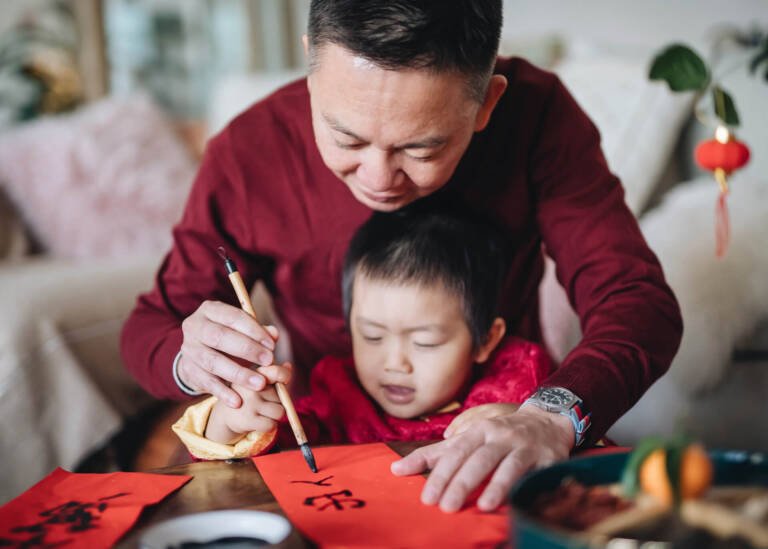
Chinese characters are the written symbols used to write Chinese and Japanese. Most modern languages employ an alphabet or phonetic script, but Chinese uses logograms — symbols representing words or meanings instead of sounds. In many cases, especially in the oldest characters, these Chinese symbols contain important clues to their meaning.Let’s learn about the history of Chinese characters, their differences from other languages, and character types that will give you a good understanding of how the Chinese language works.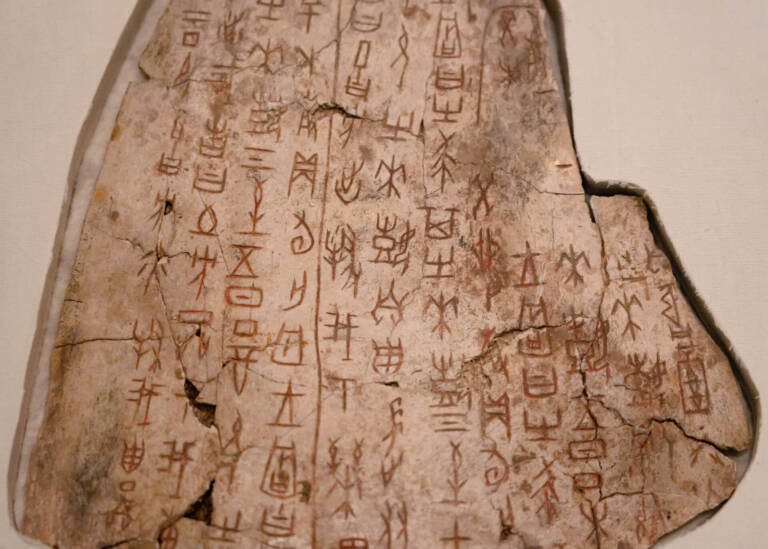
 As an example, let’s take the Chinese word 昨天 zuótiān, meaning “yesterday.” Like the majority of Chinese words, 昨天 is formed from two logograms (昨 and 天). The ancient form of 天 depicts a man with outstretched arms (大) with another mark (一) added to indicate the original meaning, “crown” or “forehead.” The Chinese used this character from ancient times to mean “sky” or “heaven.” In modern Chinese, 天 means both “sky” and “day.”The initial character (昨) functions as a morpheme or unit of meaning. We can split the English word similarly: [YESTER] + [DAY]. 昨 (“yester-“) is not a word if taken alone but is sufficiently unique to influence the word’s definition. 昨 carries this meaning in other Chinese words and phrases, such as 昨晚 zuówǎn (“yesterday evening”), 昨夜 zuóyè (“last night”), and 昨非 zuófēi — a more literary term meaning “past mistakes.”Now, let’s invent a word in English and Chinese at the same time: 昨月zuóyuè (“yestermonth”).Though this isn’t a real word, its meaning is easy to guess. Whether you read “yestermonth” in English or 昨月in Chinese, the combination in this example is very clear.Morphemes in the Chinese language have one significant advantage over English morphemes: they allow for a visual representation of the meaning.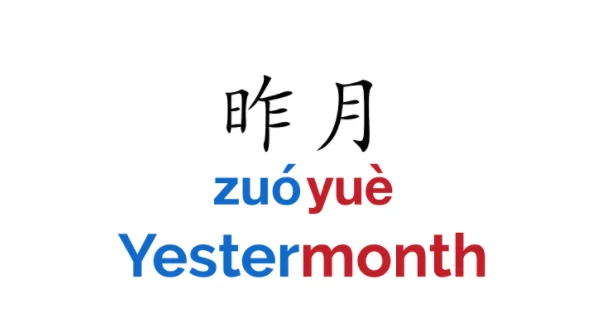

Contents
show
How old are Chinese characters?
The written Chinese language is among the most ancient forms of writing. While other ancient languages based around pictorial or logographic scripts, such as Egyptian hieroglyphics and the cuneiform of Mesopotamia, have long since disappeared, Chinese characters are used to this day.Scholars trace the history of Chinese characters back to the Shang Dynasty (1600-1050 BC). Known as the 甲骨文 jiǎgǔwén, or “oracle bone script,” these primordial inscriptions were etched into animal bones and tortoise shells.Many of these earlier characters are pictograms — simple pictures representing an object or an idea. Scholars now believe that these early Chinese characters were used in divination by fire.The writing discovered on these oracle bones was already fairly developed, suggesting that Chinese characters may date back even further. Chinese linguists have traditionally traced the Chinese writing system to the age of the Yellow Emperor, a legendary figure who united the tribes of the Yellow River under a single leader and reigned from 2697–2597 BC.Some archaeologists argue for an even earlier origin of Chinese characters, claiming that inscriptions on five-thousand-year-old artifacts unearthed in China represent more primitive forms of writing.How is Chinese writing different from other languages?
Apart from those languages that lack any written form, Chinese is the only modern language without an alphabet. Mainland China uses simplified characters, while traditional characters predominate in Hong Kong and Taiwan.Chinese characters remain in popular usage in other countries too. The Japanese language uses hanzi (known in Japan as kanji) in combination with two phonetic alphabets called hiragana and katakana where symbols represent syllables.While Koreans predominantly write in the modern Korean alphabet hangul, they still occasionally use hanzi to demonstrate ideas they find difficult to express in their own language.Chinese characters are not words or letters but symbols that represent meaning. In linguistic terms, these symbols are called morphemes — the smallest grammatical units of language that carry meaning. Some units of meaning are stand-alone words (like “day” or “sun”), but many others are not.As an example, let’s take the Chinese word 昨天 zuótiān, meaning “yesterday.” Like the majority of Chinese words, 昨天 is formed from two logograms (昨 and 天). The ancient form of 天 depicts a man with outstretched arms (大) with another mark (一) added to indicate the original meaning, “crown” or “forehead.” The Chinese used this character from ancient times to mean “sky” or “heaven.” In modern Chinese, 天 means both “sky” and “day.”The initial character (昨) functions as a morpheme or unit of meaning. We can split the English word similarly: [YESTER] + [DAY]. 昨 (“yester-“) is not a word if taken alone but is sufficiently unique to influence the word’s definition. 昨 carries this meaning in other Chinese words and phrases, such as 昨晚 zuówǎn (“yesterday evening”), 昨夜 zuóyè (“last night”), and 昨非 zuófēi — a more literary term meaning “past mistakes.”Now, let’s invent a word in English and Chinese at the same time: 昨月zuóyuè (“yestermonth”).Though this isn’t a real word, its meaning is easy to guess. Whether you read “yestermonth” in English or 昨月in Chinese, the combination in this example is very clear.Morphemes in the Chinese language have one significant advantage over English morphemes: they allow for a visual representation of the meaning.Chinese strokes, components, and radicals
Chinese text, especially when written in traditional Chinese characters, can get pretty complex. Strokes and components are the fundamental building blocks of all modern Chinese characters. As for radicals — well, more on that in a moment.Chinese strokes
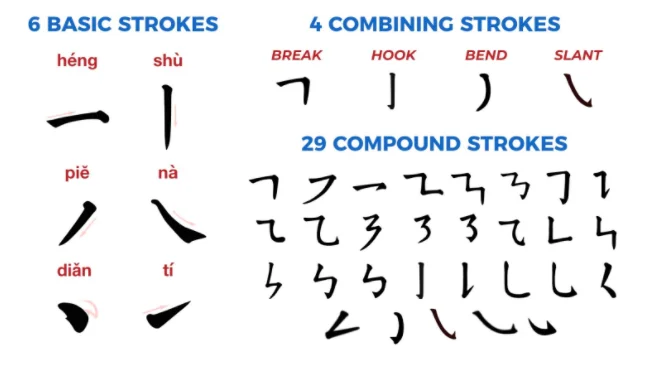
Every Chinese character is formed from six basic, four combining, and 29 compound strokes. The six basic strokes include vertical and horizontal strokes, left and right sloping strokes, a single dot, and a diagonal tick.Don’t fret over these too much for now. In the article on Chinese stroke order, we will dive into the stroke order rules and practice writing the forms by hand.Chinese components
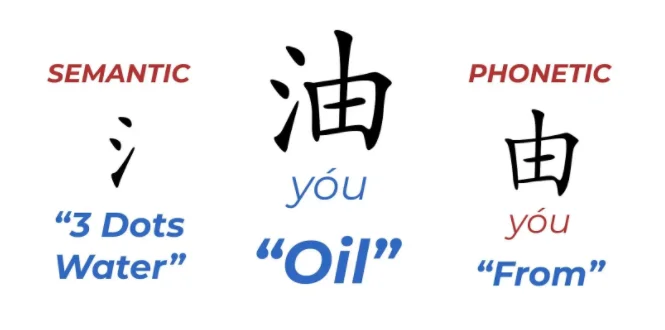
As you study the Chinese language, you’ll notice how certain forms repeatedly recur, appearing in hundreds of different characters. These components are the fundamental building blocks used in writing Chinese. The more time you invest in getting familiar with them early on, the easier you’ll find it to learn to read and write Mandarin Chinese.Some Chinese components can function as stand-alone words or characters, while others only ever appear as constituent parts. You’ll want to concentrate on those symbols that impart some information about the character, making them easier to memorize.Chinese components can have two functions:Semantic: referring to the meaningPhonetic: referring to the sound
Chinese radicals
Chinese radicals are the 214 official components listed in dictionaries. Once upon a time, looking up Chinese vocabulary in the dictionary meant searching under the correct radical. Every character is listed under one (and only one) radical, but the assignment is largely arbitrary.The process of simplification that produced the simplified Chinese characters used in mainland China today led to the semantic components in many characters being replaced by a simpler radical. These “simple characters” are easier to write but arguably more difficult to read.While the official radical list includes many semantic components, other radicals impart no information and are of little use to Chinese language students. Any Chinese-English dictionary printed in the last decade or two is more likely to list each character under the pinyin. Unless you plan on using traditional Chinese dictionaries you probably best forget radicals altogether.The 6 types of Chinese characters
One of the more charming legends surrounding the origins of Chinese characters concerns the official historian of the Yellow Emperor, Cāng Jié. Unsatisfied with the ancient method of tying knots in lengths of rope to record information, the Yellow Emperor tasked Cāng Jié with creating a novel writing system.For the longest time, Cāng Jié made no progress. But then he began to pay more attention to the distinct and individual characteristics of things in the natural world: the prints of animals, the shapes of leaves, the patterns of clouds. Cāng Jié drew his pictures as simplified representations of these characteristics, giving birth to the earliest Chinese characters.The traditional classification of Chinese characters is known as the 六书 Liùshū, the “Six Writings” or “Six Principles.” It was created during the Han dynasty (202 BC–9 AD, 25–220 AD). According to 六书, every Chinese character can be arranged into six categories:- 象形 xiàngxíng – formal representations of things in the world (“pictographs”)
- 指事 zhǐshì – symbolic, indicative signs (“ideographs” or “ideograms”)
- 会意 huìyì – combinations of two or more semantic components (“compound ideographs”)
- 形声 xíngshēng – combinations of formal and phonetic features (“phonetic-semantic compounds”)
- 转注 zhuǎnzhù – characters derived from another character with a related meaning (“transfer characters”)
- 假借 jiǎjiè – characters borrowed to represent words with similar or identical pronunciations (“loan characters”)
1. 象形字 Xiàngxíngzì – pictographs
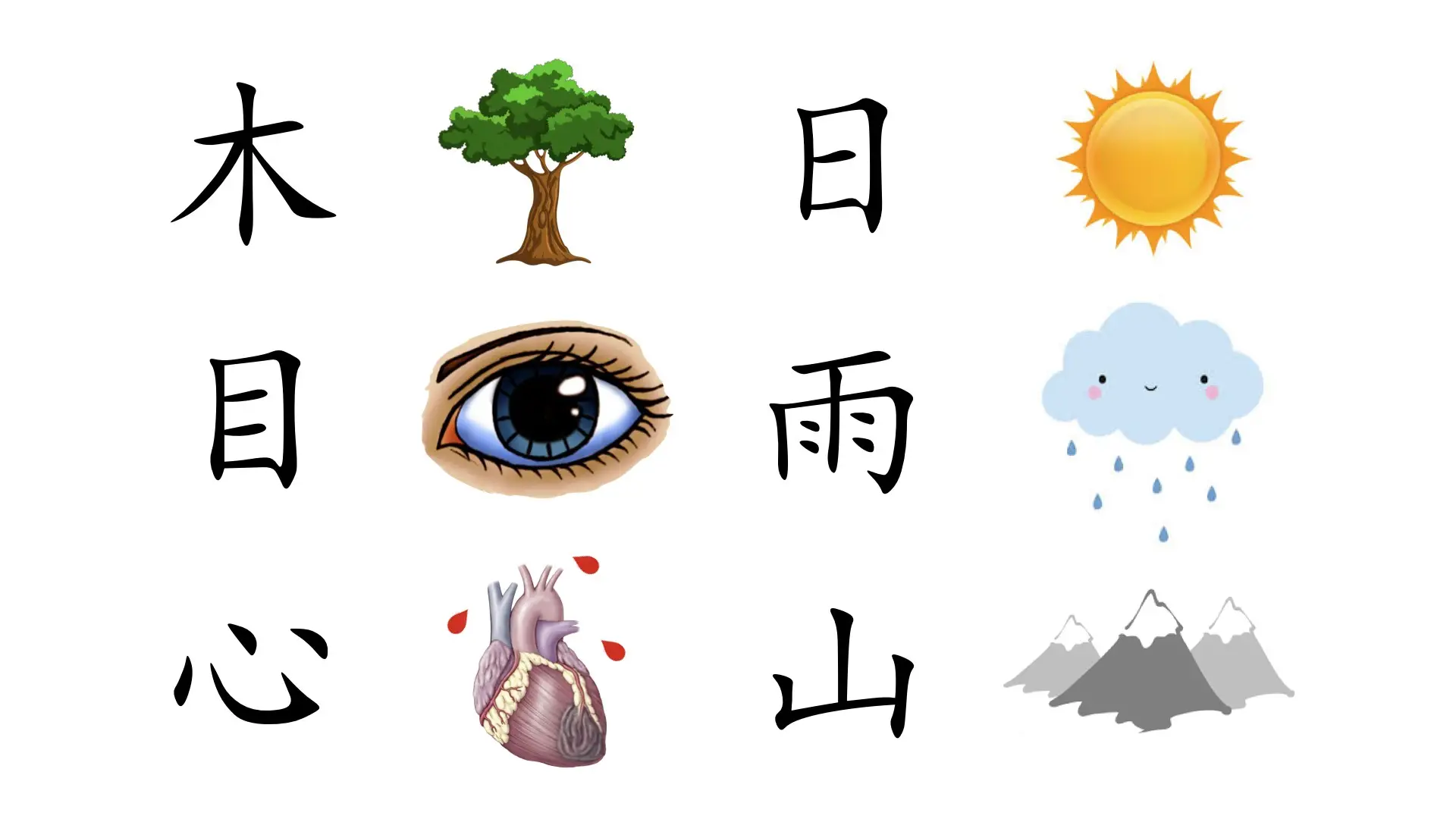
Pictographs are stylized or simplified representations of things. Think of the pictorial representations of men and women on the signs over public toilets, the green man walking across the road, or the images of sun, clouds, and rain used on weather charts. Most are simple nouns representing literal objects — rivers, mountains, trees, birds and animals, men and women, body parts, tools and weapons, the sun, and the moon.Although pictograms account for just 4 to 5% of modern Chinese characters, these easy forms include many common Chinese characters and some of the most essential and foundational semantic components — the building blocks of the Chinese writing system. Other characters that were initially pictographic include 马 mǎ (“horse”), 女 nǚ (“woman”), and 火 huǒ (“fire”).2. 指事字 Zhǐshìzì – simple ideographs
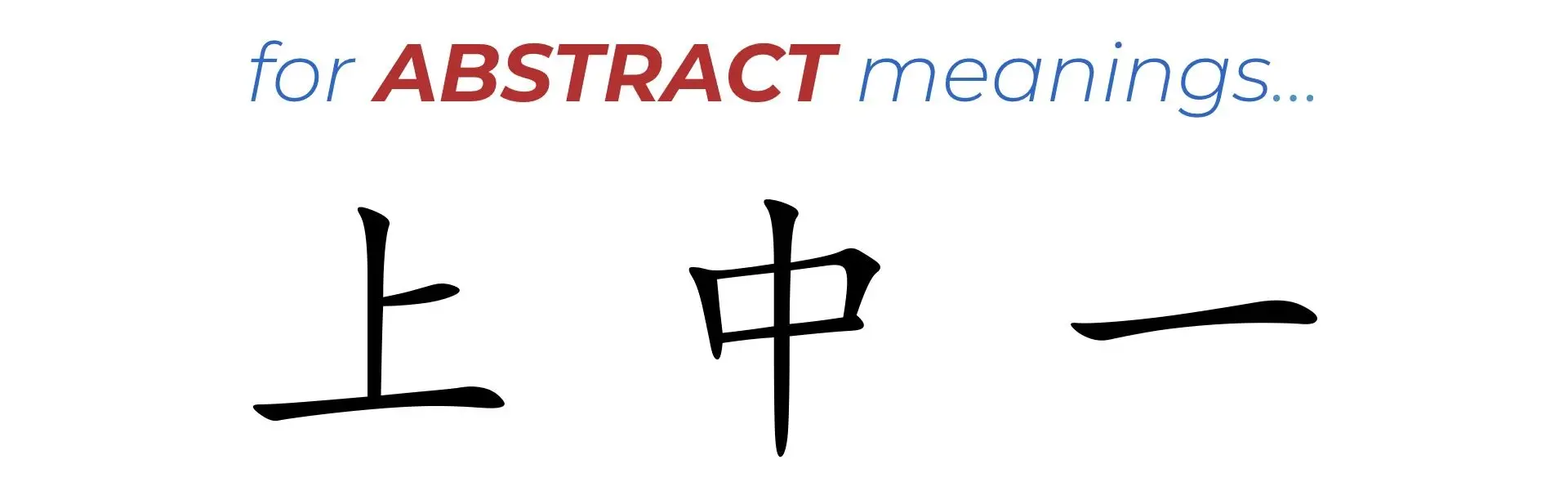
Ideographs represent abstract concepts that are difficult to express in simple images. Traffic signs (“turn left,” “no parking,” “no entry,” etc.) are good examples of ideograms used in daily life, intuitively understood, and easy to remember.Many easy Chinese characters are ideograms, including numbers (一, 二, 三), and commonly used words such as 上 shàng (“up,” “on”), 下 xià (“down,” “under”), and 中 zhōng (“middle,” “center”).3. 会意字 Huìyìzì – compound ideographs
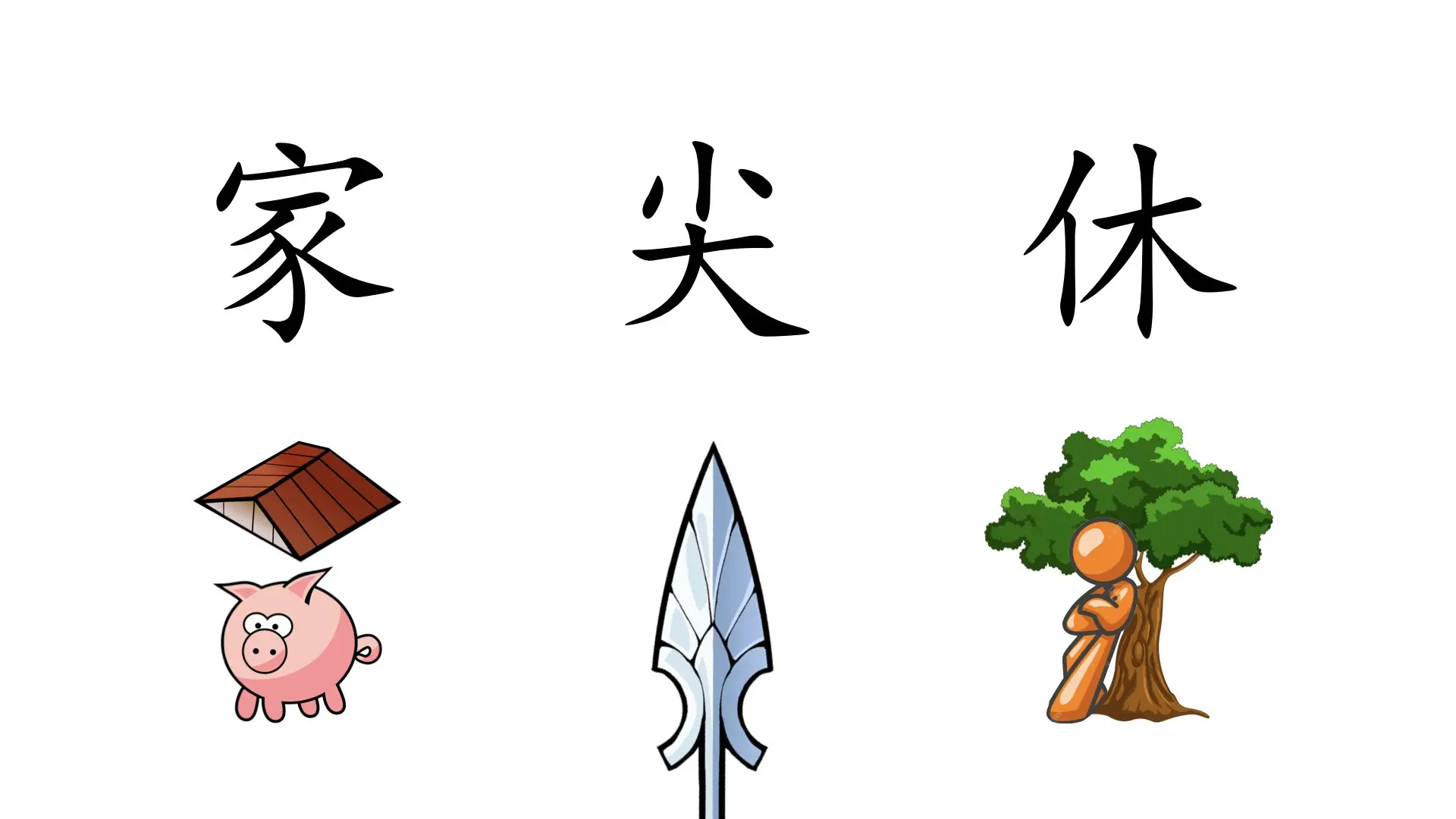
A compound ideograph combines two or more symbols to create a new Chinese character with a different meaning. Compound ideographs account for around 10% of Chinese characters and include some of the most fascinating and easy Chinese characters to learn.For example, the pictographic character 亻rén (“man” or “person”) is combined with 木 mù (“tree”) to create the compound ideogram 休 xiū (“to rest”). Think of a man resting in the shade of a tree or leaning against its trunk.Some of the most common characters are compound ideographs. With the sun 日 and the moon 月 together, we get 明 míng, meaning “bright.” Combining woman 女 and child 子 gives us 好 hǎo (“good”), and a pig 豕 under a roof 宀 becomes 家 jiā (“home”).4. 形声字 Xíngshēngzì – phonetic-semantic compounds
All phonetic-semantic compounds follow a standard principle:- One component suggests the meaning (“semantic component”)
- One component suggests the pronunciation (“phonetic component”)